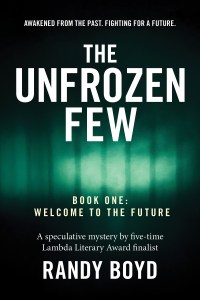
The Unfrozen Few has been reviewed by Kirkus Indie.
Below are selected highlights and the complete review.
Kirkus Indie Review
“An empathetic and layered meditation on illness and time.”
“Boyd has full control of his extensive cast, granting each of the characters complexity as they form alliances within their ‘Emergence.’”
“…introduces complex themes related to living with HIV and AIDS, including survivor’s guilt, positionality in the LGBTQ+ community, and fluid sexual identities, in a carefully considered way.”
— Kirkus Indie
February 11, 2026
Full Review
In Boyd’s speculative novel, the subjects of an experimental AIDS treatment awaken after decades of suspended animation.
Dr. Nathan Black wakes from a cryogen-induced sleep in an abandoned underground laboratory alongside ten other AIDS patients. The patients and their experimental treatment program have been long forgotten, since all “traces of Project I.C.E. disappeared during the cryogenic catastrophe scandal of ’95.” When the group emerges, confused and scared, in 2023, Nathan wants answers from the people at the biotech company who carried out the experiment—namely, his brother, Dr. Frankie Black, and his friend, Dr. J.J. Fletcher, both of whom have disappeared. As the unfrozen venture out into Duranga Valley, California, they discover that the biotech company, Black Ops, is now run by Dr. Brenda Black, Nathan’s stepmother, and her children, Nathan’s stepsiblings. The staff is determined to keep the unfrozen few from seeing the outside world until they’re up to speed to prevent brain glitches. (“None of you are ready. Not because the world is on fire, but because your minds are still dazed and confused, like you’ve been zapped into another dimension.”) But when a smartphone comes into the patients’ collective hands, they receive an overwhelming update about the state of the modern world, including the advents of Covid-19 and social media. As they try to contact their loved ones, Nathan digs into the truth behind the “frozen formula” and its absent architects while monitoring Brenda’s increasingly suspicious behavior.
Boyd has full control of his extensive cast, granting each of the characters complexity as they form alliances within their “Emergence.” The action is fast-paced and dialogue-heavy, with Nathan acting as a bridge between the patients and the world outside the compound. Through the group’s conversations, the author introduces complex themes related to living with HIV and AIDS, including survivor’s guilt, positionality in the LGBTQ+ community, and fluid sexual identities, in a carefully considered way.
An empathetic and layered meditation on illness and time.
— Kirkus Indie
 Randy Boyd author